This week brought discoveries spanning the very small to the very large — from a brand-new subatomic particle forged inside CERN’s collider to an alien world with oceans of magma and an atmosphere that smells of rotten eggs. In between, scientists found the complete genetic alphabet on an asteroid, turned friendly bacteria into cancer-fighting machines, cracked a 12,800-year-old climate mystery, and confirmed that our planet is warming faster than ever. Here are six stories worth knowing about.
1. CERN Discovers a New “Heavy Proton”
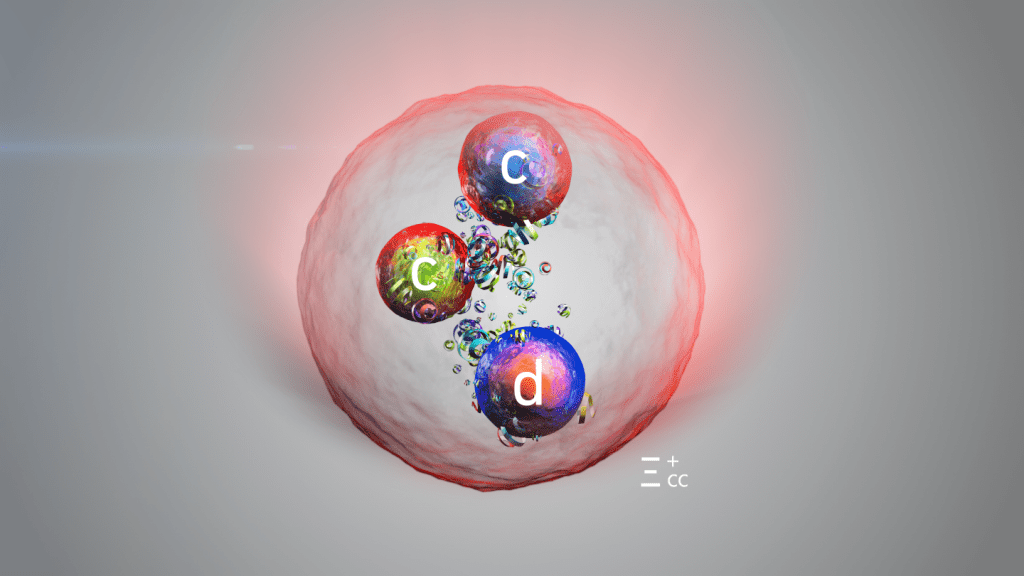
Image credit: CERN (open access) — view source image
Physicists at CERN’s Large Hadron Collider have discovered a new subatomic particle called Xi-cc-plus. It has the same three-quark structure as the familiar proton, but with two of its lightweight “up” quarks replaced by heavier “charm” quarks — making it roughly four times heavier than a normal proton. The discovery was made using the recently upgraded LHCb detector and announced at the Moriond physics conference with a statistical significance of 7 sigma.
What makes this particularly satisfying is that it settles a 20-year debate. A previous experiment claimed to have spotted this particle in the early 2000s, but at a mass that didn’t match theoretical predictions. The LHCb team has now found it at the mass physicists expected. The particle is incredibly short-lived, with a lifetime predicted to be up to six times shorter than its close relative discovered in 2017. It’s the 80th particle discovered at the LHC and provides valuable new data for understanding quantum chromodynamics — the theory of how the strong nuclear force binds matter together.
Think About It: The proton was discovered by Rutherford in Manchester over 100 years ago using relatively simple equipment. This new “heavy proton” required a 27 km underground ring and thousands of scientists. What does this tell us about how scientific discovery has changed?
2. All Five DNA Building Blocks Found on Asteroid Ryugu
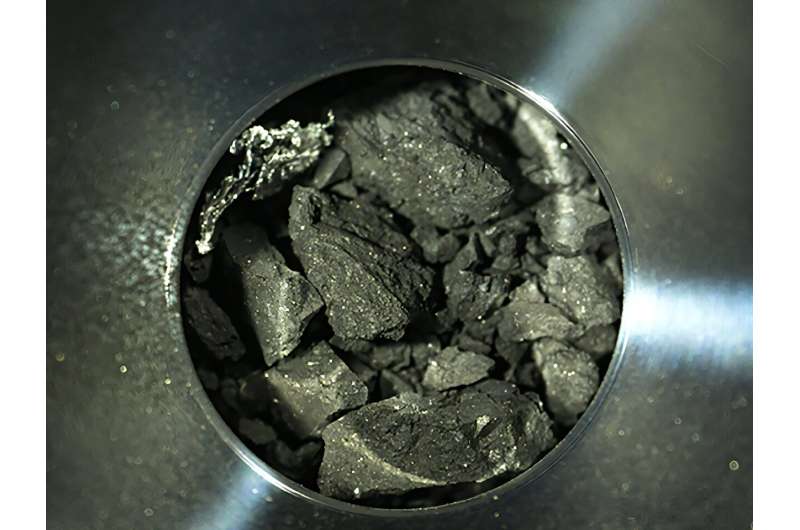
Image credit: JAXA/JAMSTEC — view source image
Scientists analysing samples returned from asteroid Ryugu by Japan’s Hayabusa-2 spacecraft have confirmed the presence of all five nucleobases — adenine, guanine, cytosine, thymine, and uracil — the complete set of molecular “letters” needed to build DNA and RNA. The study, published in Nature Astronomy, builds on earlier work that had detected only uracil. This time, a more detailed analysis revealed the full set, in roughly equal proportions.
The Ryugu samples are especially valuable because they were collected directly in space and sealed for return to Earth, meaning they haven’t been contaminated by our planet’s own chemistry. Researchers compared Ryugu’s nucleobase composition with samples from asteroid Bennu and two meteorites — Murchison and Orgueil. Each showed different ratios, likely reflecting different chemical histories. The team also discovered a previously unknown correlation between nucleobase ratios and ammonia concentrations, hinting at a new chemical pathway. None of this means life existed on Ryugu — but it strengthens the idea that asteroids could have delivered key molecular ingredients to the early Earth.
Think About It: If the building blocks of DNA are common across the solar system, does that make it more or less likely that life exists elsewhere? What other ingredients and conditions would still be needed?
3. Engineered Bacteria Become Tumour-Hunting Drug Factories
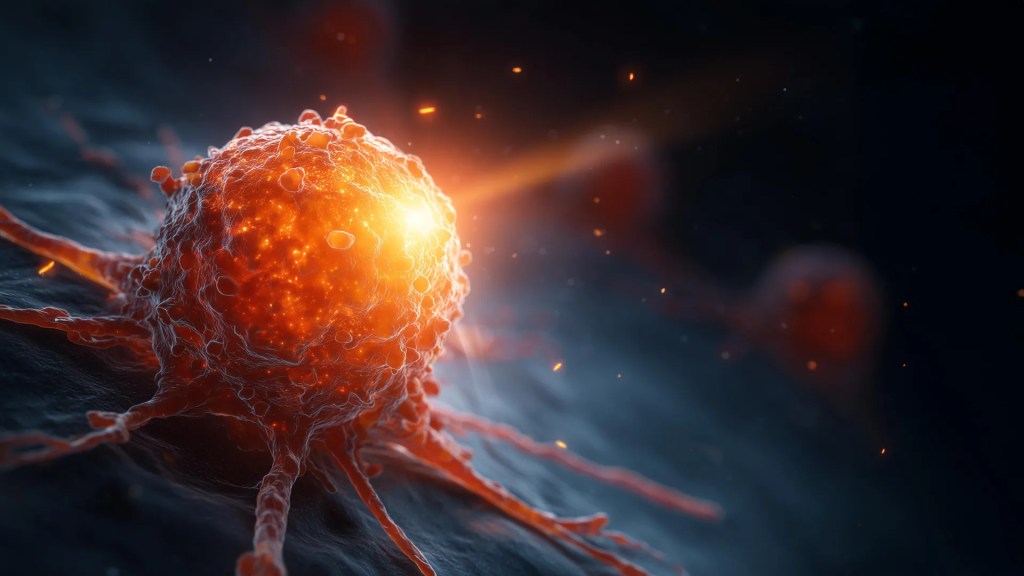
Image credit: PLOS Biology (CC-BY 4.0) — view source image
Researchers at Shandong University have engineered a common probiotic bacterium, Escherichia coli Nissle 1917, to act as a living drug factory that seeks out tumours and delivers cancer-fighting compounds directly where they’re needed. The team genetically modified the bacteria to produce Romidepsin (FK228), an FDA-approved anti-cancer drug, and tested them in mice with breast cancer tumours. The results, published in PLOS Biology, showed that the engineered bacteria successfully colonised the tumours and released the drug on-site.
The approach tackles one of cancer treatment’s biggest challenges: getting drugs to the right place. Traditional chemotherapy floods the entire body with toxic compounds. Bacteria, however, are naturally drawn to the low-oxygen environment inside tumours, making them ideal delivery vehicles. The targeted production also reduced the heart toxicity that Romidepsin normally causes. This is still early-stage research — it hasn’t been tested in humans, and questions remain about safety. But it represents an exciting proof-of-concept for using synthetic biology to create precision cancer therapies.
Think About It: We usually think of E. coli as harmful, yet this probiotic strain is being used to fight cancer. What does this tell us about the complexity of our relationship with bacteria?
4. JWST Discovers a “Sulfur World” — An Entirely New Type of Planet
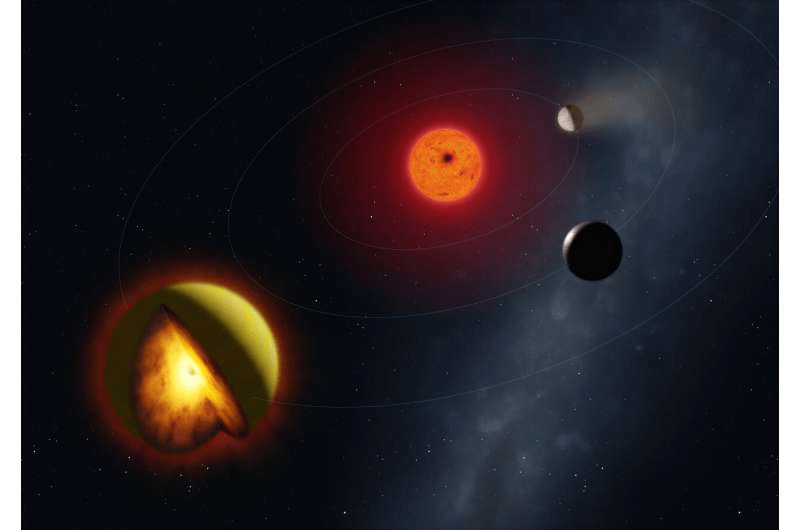
Image credit: Mark A. Garlick / markgarlick.com via University of Oxford — view source image
Astronomers using the James Webb Space Telescope have identified an exoplanet that doesn’t fit into any existing category. L 98-59 d, orbiting a small red dwarf star just 35 light-years from Earth, is about 1.6 times the size of our planet but has a surprisingly low density and an atmosphere rich in hydrogen sulfide — the gas responsible for the smell of rotten eggs.
Using computer simulations spanning nearly five billion years, a team from Oxford, Groningen, Leeds, and ETH Zurich reconstructed the planet’s history. It appears to have a global magma ocean stretching thousands of kilometres deep, acting as a giant reservoir trapping sulfur compounds. Over billions of years, chemical exchanges between this molten interior and the atmosphere produced the unusual sulfur-rich signature JWST detected. The researchers suggest it could be the first recognised member of an entirely new class of sulfur-dominated magma planets — suggesting our categories for classifying planets may be too simple.
Think About It: Scientists had to invent a new category for this planet. How important is classification in science? Can you think of other examples where a discovery forced scientists to rethink their categories?
5. Greenland Ice Solves a 12,800-Year-Old Climate Mystery
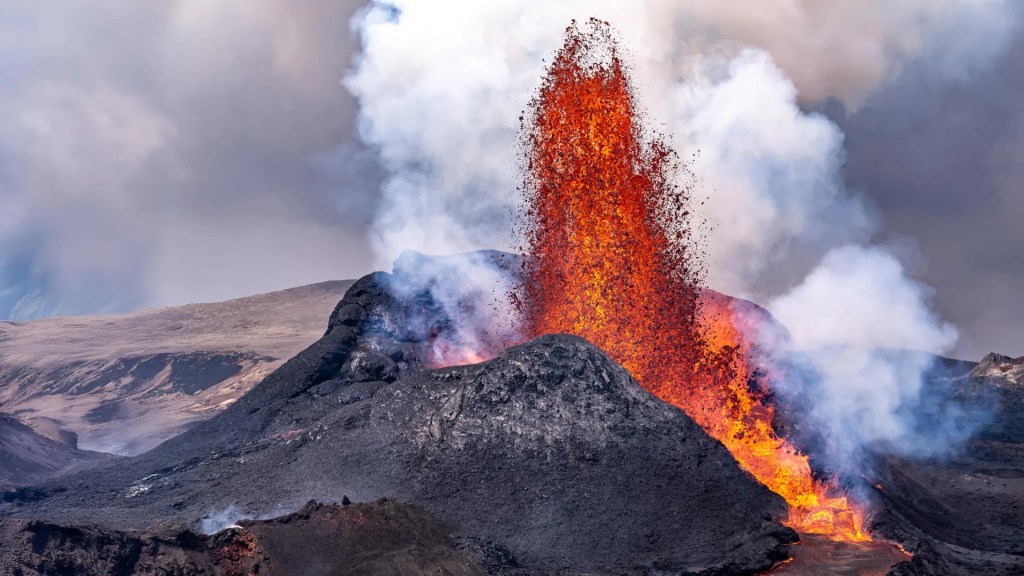
Image credit: Shutterstock via ScienceDaily — view source image
A mysterious spike of platinum found deep in Greenland’s ice sheet has puzzled scientists for over a decade. Some argued it was evidence of a catastrophic comet strike around 12,800 years ago, triggering the Younger Dryas — a sudden 1,000-year return to ice-age conditions. New research in PLOS One points to a more likely explanation: volcanic eruptions.
The team analysed 17 samples of volcanic pumice from Germany’s Laacher See eruption and found virtually no platinum, ruling it out. Updated ice core dating revealed the platinum spike occurred about 45 years after the cooling began — too late to be the trigger. The elevated levels lasted 14 years, consistent with a prolonged volcanic fissure eruption rather than an instantaneous impact. The closest chemical match came from volcanic gas condensates from submarine eruptions. Iceland, with dramatically increased volcanic activity as melting ice sheets reduced crustal pressure, is the prime suspect.
Think About It: The comet hypothesis was dramatic and grabbed headlines, but evidence now points to volcanoes. Why do you think dramatic explanations are often more popular in science communication?
6. Global Warming Has Accelerated Since 2015

Image credit: Shutterstock via Potsdam Institute/ScienceDaily — view source image
A new analysis from the Potsdam Institute for Climate Impact Research confirms global warming has accelerated significantly over the past decade. By stripping out natural climate influences — El Nino events, volcanic eruptions, and solar cycles — the researchers isolated the underlying human-driven trend and found a clear acceleration beginning around 2015.
During the past decade, global temperatures have been climbing at roughly 0.35 degrees C per decade, nearly double the 0.2 degrees C per decade observed between 1970 and 2015. This is the fastest warming rate since records began in 1880. The findings suggest the planet could exceed the critical 1.5 degree C threshold before 2030. The acceleration implies that some aspects of the climate system may be responding to greenhouse gas emissions more sensitively than earlier models predicted.
Think About It: The researchers had to remove natural factors (El Nino, volcanoes, solar cycles) to see the human-caused trend clearly. Why is separating variables so important in science? How does this relate to controlling variables in your own experiments?
That’s your science roundup for the week of 17 March 2026. From the tiniest quarks to the largest planets, it’s been a week that reminds us how much we’re still discovering. Have a favourite story? Let us know in the comments or share this post with someone who’d enjoy it.
 Practical Science