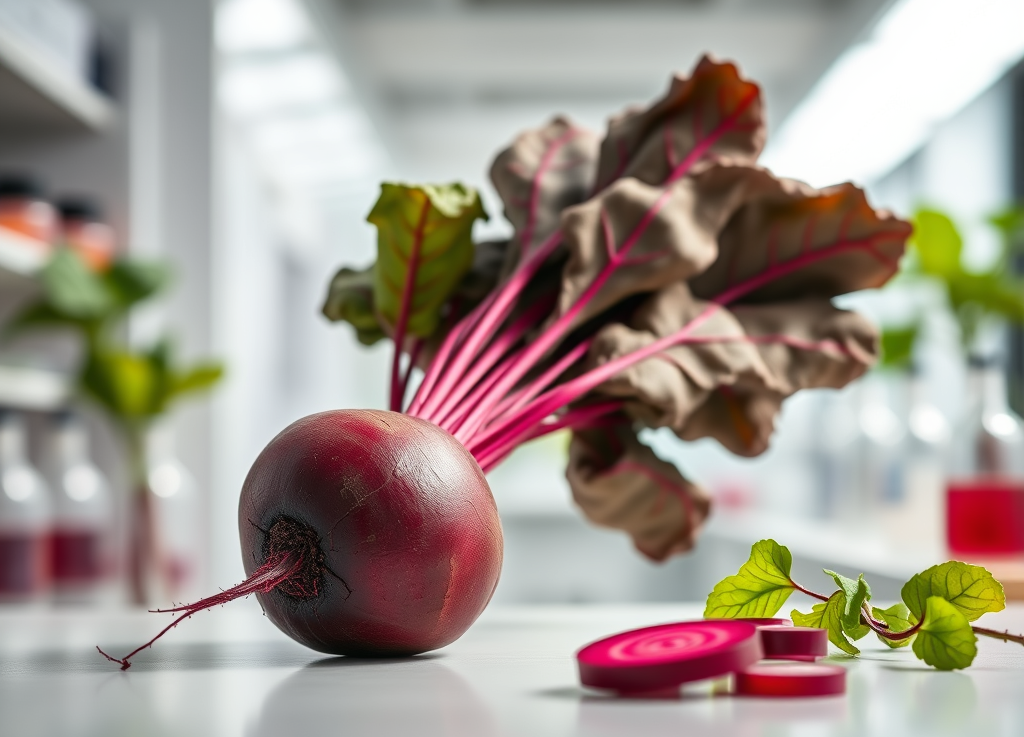
In this investigation, you will use beetroot tissue to explore how increasing temperature affects the permeability of cell membranes. As membranes are damaged by heat, the red pigment anthocyanin leaks out of the vacuole — the more pigment released, the more permeable the membrane has become. A colorimeter is used to measure absorbance quantitatively, making this an excellent IB Biology IA investigation.
This practical is suitable for IB Diploma Biology and Edexcel IGCSE Biology students.
Background Theory
The cell surface membrane and tonoplast (vacuolar membrane) are both phospholipid bilayers. At low temperatures, the phospholipids are tightly packed and the membrane is relatively impermeable. As temperature increases, the phospholipids become more fluid, proteins denature, and the membrane loses its structural integrity. This allows the contents of the vacuole — including the red-purple pigment anthocyanin — to leak into the surrounding solution.
The degree of leakage can be measured using a colorimeter set to a green filter (approximately 530 nm), which measures absorbance of the red anthocyanin solution. Higher absorbance indicates greater membrane damage and increased permeability.
Variables
- Independent variable (IV): Temperature of water bath (°C)
- Dependent variable (DV): Absorbance of surrounding solution measured by colorimeter (arbitrary units)
- Controlled variables (CV): Size and surface area of beetroot discs, mass of beetroot used, volume of distilled water, time beetroot is left in water bath, same colorimeter and filter used throughout
Equipment
- Fresh beetroot
- Cork borer (same size throughout)
- Ruler and scalpel or cutting tile
- Distilled water
- 6 water baths (or temperature-controlled beakers) at 10, 20, 30, 40, 50, and 60 °C
- Thermometer (±0.5 °C)
- Boiling tubes or small beakers (one per temperature)
- Colorimeter with green filter (~530 nm)
- Colorimeter cuvettes
- Stopwatch
- Forceps
Safety
⚠️ Take care when using a scalpel — always cut away from fingers on a cutting tile. Hot water baths above 50 °C present a scalding risk; use forceps to handle tubes. Dispose of all solutions and beetroot tissue into the appropriate waste disposal bottles and bins provided.
Method
- Use a cork borer to cut uniform cylinders of beetroot. Slice into discs approximately 5 mm thick using a ruler and scalpel. You need 3 discs per temperature (18 total).
- Rinse all beetroot discs thoroughly in distilled water until the rinse water runs clear. This removes any anthocyanin released during cutting.
- Set up six water baths at 10, 20, 30, 40, 50, and 60 °C. Add 5 cm³ of distilled water to each boiling tube and allow to equilibrate to the target temperature for 5 minutes.
- Add 3 beetroot discs to each boiling tube. Record the exact temperature. Leave for exactly 15 minutes.
- Remove the beetroot discs using forceps. Pour the surrounding solution into a colorimeter cuvette.
- Calibrate the colorimeter to zero absorbance using distilled water (blank).
- Measure and record the absorbance of each sample using a green filter.
- Repeat for all six temperatures. Carry out at least three replicates per temperature and calculate a mean absorbance.
Results Table
| Temperature (°C) | Absorbance 1 | Absorbance 2 | Absorbance 3 | Mean Absorbance |
|---|---|---|---|---|
| 10 | ||||
| 20 | ||||
| 30 | ||||
| 40 | ||||
| 50 | ||||
| 60 |
Analysis
1. Plot a graph of mean absorbance (y-axis) against temperature (x-axis). Draw a smooth curve of best fit.
2. Describe the trend. At what temperature does absorbance begin to increase significantly? This suggests the temperature at which membrane integrity starts to fail.
3. Is there a sharp transition point or a gradual increase? What does this suggest about membrane denaturation?
4. Calculate the percentage increase in absorbance between your lowest and highest temperatures.
Discussion Points
- Why is it important to rinse the beetroot discs before the experiment?
- Why does absorbance increase at higher temperatures? Refer to the fluid mosaic model and the effect of heat on phospholipids and membrane proteins.
- Why is a green filter used in the colorimeter when measuring a red/purple solution?
- What would happen to the results if you used beetroot that had been frozen and thawed? Explain in terms of ice crystal damage to membranes.
- Why is distilled water used rather than tap water?
IA Guidance
This is one of the most popular and reliable IB Biology IA investigations. To score highly:
- Research Design: Justify your temperature range and intervals. Explain why a colorimeter gives more reliable data than visual comparison. Identify and explain all controlled variables, particularly surface area — consider using mass instead of disc count.
- Data Analysis: Include error bars (standard deviation) on your graph. Comment on the shape of the curve and identify any threshold temperature. Consider calculating rate of change between temperature intervals.
- Conclusion: Link your findings explicitly to the fluid mosaic model. Compare your threshold temperature to published values for membrane protein denaturation (~40–45 °C).
- Evaluation: Discuss whether temperature was held constant throughout the incubation period. Suggest using a spectrophotometer for greater precision, or controlling for beetroot age and variety as potential confounding variables.
 Practical Science