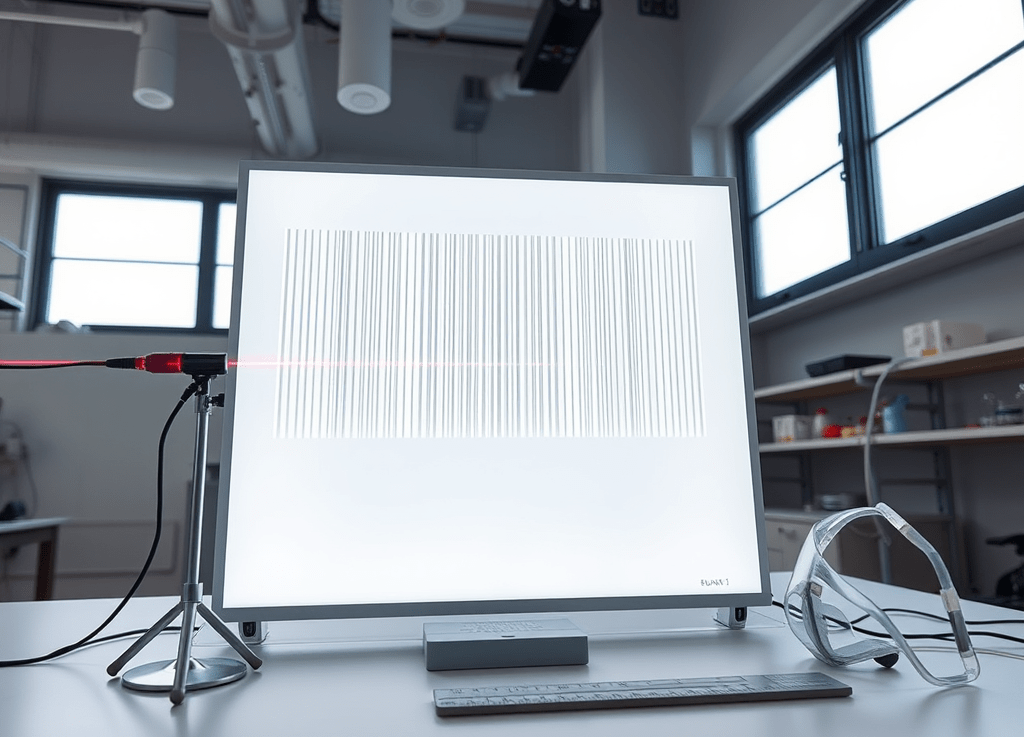
Young’s double-slit experiment is one of the most elegant demonstrations in physics. By passing light through two closely spaced slits, an interference pattern of bright and dark fringes is produced on a screen. Measuring the fringe spacing allows you to calculate the wavelength of the light used. This makes it an excellent IB Diploma Physics HL Internal Assessment investigation.
This practical is suitable for IB Diploma Physics HL and Edexcel IGCSE Physics students.
Background Theory
When coherent monochromatic light passes through two slits separated by distance d, the waves from each slit interfere. Where path differences are whole wavelengths, constructive interference produces bright fringes. Where path differences are half wavelengths, destructive interference produces dark fringes.
The fringe spacing w is related to the wavelength λ by:
λ = wd / D
Where:
- λ = wavelength of light (m)
- w = fringe spacing, centre-to-centre distance between adjacent bright fringes (m)
- d = slit separation (m)
- D = distance from slits to screen (m)
This equation holds when D >> d, which is satisfied in a typical school laboratory setup. By measuring w at several values of D, a graph of w vs D can be plotted — the gradient equals λ/d, allowing a precise determination of wavelength.
Variables
- Independent variable (IV): Distance from slits to screen, D (m)
- Dependent variable (DV): Fringe spacing, w (m)
- Controlled variables (CV): Wavelength of light (same laser or light source throughout), slit separation d, alignment of laser perpendicular to slits and screen
Using D as the continuous IV and plotting w vs D produces a straight line through the origin with gradient λ/d — ideal for IA analysis.
Equipment
- Laser pointer or laser diode (e.g. red 650 nm or green 532 nm) — class 2 or lower for school use
- Double-slit slide (slit separation d typically 0.25 mm or 0.50 mm — check manufacturer value)
- Optical bench or metre ruler for measuring D
- White screen or plain white paper on a stand
- Ruler or travelling microscope for measuring fringe spacing
- Retort stand and clamps
- Laser safety goggles
Safety
⚠️ Never look directly into a laser beam or its reflection. Wear appropriate laser safety goggles at all times. Ensure the laser is secured and cannot be knocked to point at eyes. There are no chemical hazards in this experiment — no waste disposal required.
Method
- Set up the laser, double-slit slide, and screen on an optical bench. Ensure the laser beam is perpendicular to the slits and screen.
- Turn on the laser and observe the interference pattern on the screen. Adjust alignment until the fringes are clear, evenly spaced, and symmetrical.
- Set D = 0.50 m. Using a ruler, measure the total width across as many fringes as possible (e.g. 10 fringe spacings). Divide by the number of spacings to find w. Record D and w.
- Increase D in steps of 0.10 m up to 1.50 m (or the maximum your bench allows). At each value of D, measure w as in step 3.
- Repeat each measurement of w three times and calculate a mean value.
- Record the slit separation d from the manufacturer’s specification or measure using a travelling microscope if available.
Results Table
| D (m) | w measurement 1 (m) | w measurement 2 (m) | w measurement 3 (m) | Mean w (m) |
|---|---|---|---|---|
| 0.50 | ||||
| 0.60 | ||||
| 0.70 | ||||
| 0.80 | ||||
| 0.90 | ||||
| 1.00 | ||||
| 1.20 | ||||
| 1.50 |
Analysis
1. Plot a graph of mean w (y-axis, in m) against D (x-axis, in m). The relationship should be linear and pass through the origin.
2. Draw a best-fit straight line. Calculate the gradient:
gradient = Δw / ΔD = λ / d
3. Rearrange to find the wavelength:
λ = gradient × d
4. Compare your calculated λ to the known wavelength of your laser (e.g. 650 nm for red, 532 nm for green). Calculate the percentage error.
5. Draw worst-case lines (maximum and minimum gradient) to determine the uncertainty in your value of λ.
Discussion Points
- Why must the light source be coherent and monochromatic for a clear interference pattern to form?
- Why is it better to measure across 10 fringe spacings rather than just one?
- Why does the fringe spacing increase as D increases?
- What would happen to the fringe spacing if a smaller slit separation d were used? Explain using λ = wd/D.
- Why does the graph pass through the origin?
- What effect would using a shorter wavelength laser (e.g. blue, 450 nm) have on the pattern?
IA Guidance
This is a classic IB Physics IA that rewards careful experimental technique. To score highly:
- Research Design: Justify your range of D values and explain why plotting w vs D (rather than calculating λ directly at each point) gives a more reliable result. Explain why a laser is used rather than a white light source.
- Data Analysis: Include error bars on your graph based on the uncertainty in measuring w (consider the resolution of your ruler and the difficulty of locating fringe centres precisely). Use worst-case lines to find the uncertainty in the gradient and propagate this to find δλ.
- Conclusion: State your value of λ with its uncertainty (e.g. 650 ± 20 nm). Compare to the accepted value and discuss whether it falls within your uncertainty range.
- Evaluation: Discuss the main sources of error: alignment of the laser, accuracy of measuring fringe spacing (especially if fringes are not sharp), and the precision of the manufacturer’s slit separation value. Suggest using a travelling microscope to improve fringe measurement precision.
 Practical Science