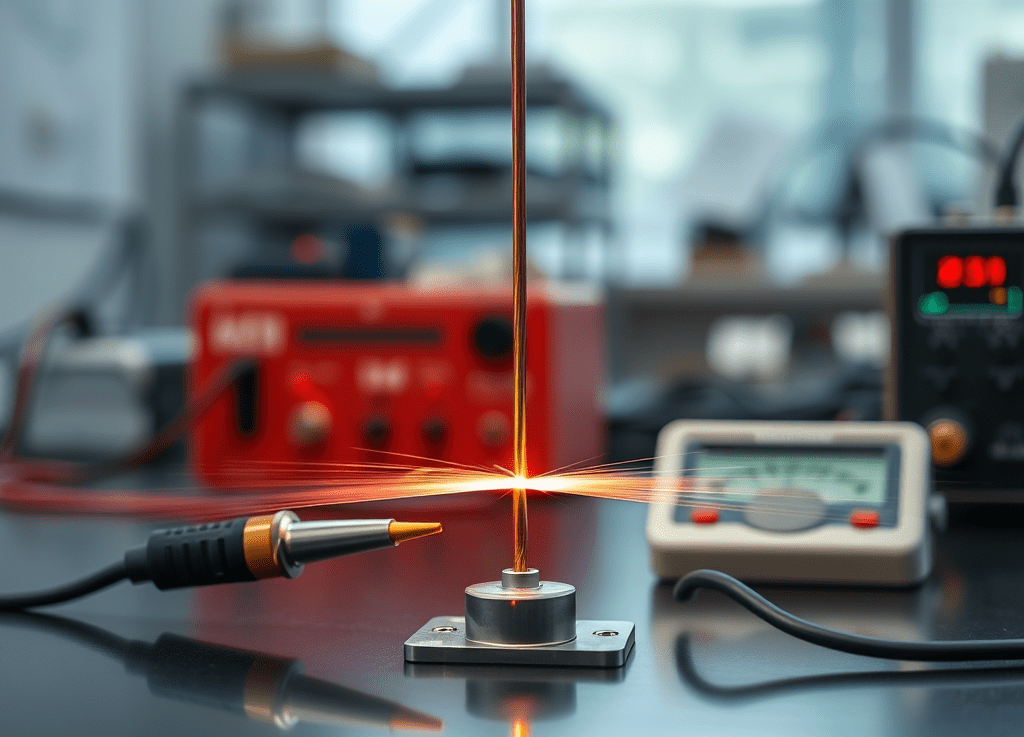
In this investigation, you will measure how the magnetic field strength around a long straight current-carrying wire varies with distance. Using a Hall probe (or a compass and plotting paper as an alternative), you will collect quantitative data and test whether the relationship follows the theoretical inverse proportionality predicted by Ampère’s law. This is an excellent IB Diploma Physics HL Internal Assessment topic.
This practical is suitable for IB Diploma Physics HL students.
Background Theory
A long straight wire carrying a current I produces a magnetic field that forms concentric circles around the wire. The magnetic field strength B at a perpendicular distance r from the wire is given by the Biot-Savart law (simplified for an infinite straight wire):
B = μ₀I / 2πr
Where:
- B = magnetic field strength (T)
- μ₀ = permeability of free space = 4π × 10⁻⁷ T m A⁻¹
- I = current in wire (A)
- r = perpendicular distance from wire (m)
This equation predicts that B is inversely proportional to r: doubling the distance halves the field strength. To test this, a graph of B vs 1/r should be linear and pass through the origin. The gradient of this line equals μ₀I / 2π, which can be used to calculate μ₀ if I is known — a powerful IA result.
Variables
- Independent variable (IV): Distance from the wire, r (m)
- Dependent variable (DV): Magnetic field strength, B (T or mT), measured by Hall probe
- Controlled variables (CV): Current through wire (kept constant using ammeter and variable resistor), orientation of Hall probe relative to field, same wire and circuit throughout, temperature (resistance of wire affects current)
Equipment
- Long straight wire (at least 50 cm, fixed vertically or horizontally on a stand)
- DC power supply (capable of 3–5 A)
- Ammeter (to monitor current)
- Variable resistor (rheostat) to control current
- Hall probe connected to a calibrated voltmeter or magnetic field meter (e.g. Pasco or Vernier)
- Retort stand and clamps to hold wire and probe
- Ruler or optical bench for measuring r (±0.5 mm)
- Connecting wires and switch
Alternative (compass method): If a Hall probe is unavailable, a small plotting compass can be used. Place the compass at each distance and measure the deflection angle θ from the Earth’s field. Using Bᵡᵢᵣᵉ = Bᴼ tan(θ) allows calculation of Bᵡᵢᵣᵉ, where Bᴼ is the known horizontal component of Earth’s magnetic field at your location (~20 μT in Hong Kong).
Safety
⚠️ Currents of 3–5 A will cause the wire to heat up — do not leave the circuit on continuously. Switch off between readings. Ensure all connections are secure before switching on. There are no chemical hazards — no waste disposal required.
Method
- Set up the long straight wire vertically in a retort stand. Connect it in series with the power supply, ammeter, variable resistor, and switch.
- Mount the Hall probe on a second stand so it can be positioned at measured distances from the wire. Ensure the probe is oriented to measure the field component perpendicular to the wire (tangential to the concentric field circles).
- Switch on the circuit and adjust the variable resistor until the current reads exactly your chosen value (e.g. 4.0 A). Record this current.
- Position the Hall probe at r = 1.0 cm from the wire. Record the field reading B. Switch off immediately after each reading.
- Increase r in steps (e.g. 1.0, 1.5, 2.0, 2.5, 3.0, 4.0, 5.0, 6.0, 8.0, 10.0 cm). At each distance, switch on, record B, then switch off.
- Check the current is still correct before each reading and adjust if necessary.
- Repeat the full set of readings three times and calculate mean B at each distance.
Results Table
| r (m) | 1/r (m⁻¹) | B₁ (mT) | B₂ (mT) | B₃ (mT) | Mean B (mT) |
|---|---|---|---|---|---|
| 0.010 | 100 | ||||
| 0.015 | 66.7 | ||||
| 0.020 | 50.0 | ||||
| 0.025 | 40.0 | ||||
| 0.030 | 33.3 | ||||
| 0.040 | 25.0 | ||||
| 0.050 | 20.0 | ||||
| 0.060 | 16.7 | ||||
| 0.080 | 12.5 | ||||
| 0.100 | 10.0 |
Analysis
1. Plot a graph of mean B (y-axis, in T) against 1/r (x-axis, in m⁻¹). If B ∝ 1/r, this graph should be linear and pass through the origin.
2. Draw a best-fit straight line and calculate the gradient:
gradient = ΔB / Δ(1/r) = μ₀I / 2π
3. Rearrange to find the permeability of free space:
μ₀ = gradient × 2π / I
4. Compare your calculated μ₀ to the accepted value of 4π × 10⁻⁷ T m A⁻¹ (approximately 1.257 × 10⁻⁶ T m A⁻¹). Calculate the percentage error.
5. Draw worst-case lines to find the uncertainty in the gradient and propagate this to δμ₀.
6. You can also plot ln(B) vs ln(r) — if B ∝ rⁿ, the gradient of this log-log graph gives the power n. Theory predicts n = −1.
Discussion Points
- Why does the field strength decrease with distance? Relate your answer to the geometry of the field lines around a straight wire.
- Why is it important to keep the current constant throughout? How does resistance change with temperature affect this?
- Why should the wire be as long as possible relative to the distances measured?
- Why must the Hall probe be oriented correctly relative to the field direction? What would happen if it were rotated 90°?
- How does the Earth’s background magnetic field affect your measurements, and how could this be accounted for?
- Compare the inverse (1/r) relationship with the inverse square (1/r²) relationship seen in gravitational and electric fields. Why does a straight wire give 1/r rather than 1/r²?
IA Guidance
This is an outstanding IB Physics IA because it produces a clean linear graph, allows calculation of a fundamental physical constant (μ₀), and involves sophisticated uncertainty analysis. To score highly:
- Research Design: Justify your range of r values and your choice of current. Explain why plotting B vs 1/r is more informative than B vs r. Describe how you will control the current and why this is critical.
- Data Analysis: Include error bars on your graph based on the uncertainty in both B (resolution of Hall probe) and r (ruler precision). Use worst-case lines to determine the uncertainty in the gradient. Propagate this to find δμ₀. Consider also producing a ln-ln plot to confirm the power law experimentally.
- Conclusion: State your value of μ₀ with uncertainty. Does the accepted value fall within your uncertainty range? Discuss any systematic errors such as the wire not being perfectly straight, nearby ferromagnetic objects, or background fields.
- Evaluation: Suggest using a data logger to continuously monitor current and automatically flag any drift. Consider using a Helmholtz coil to cancel the Earth’s field for more precise measurements at larger distances.
 Practical Science